
Uzbekistan · We are based here
Samarkand tours and travel guide
The crossroads of cultures, written in turquoise tile
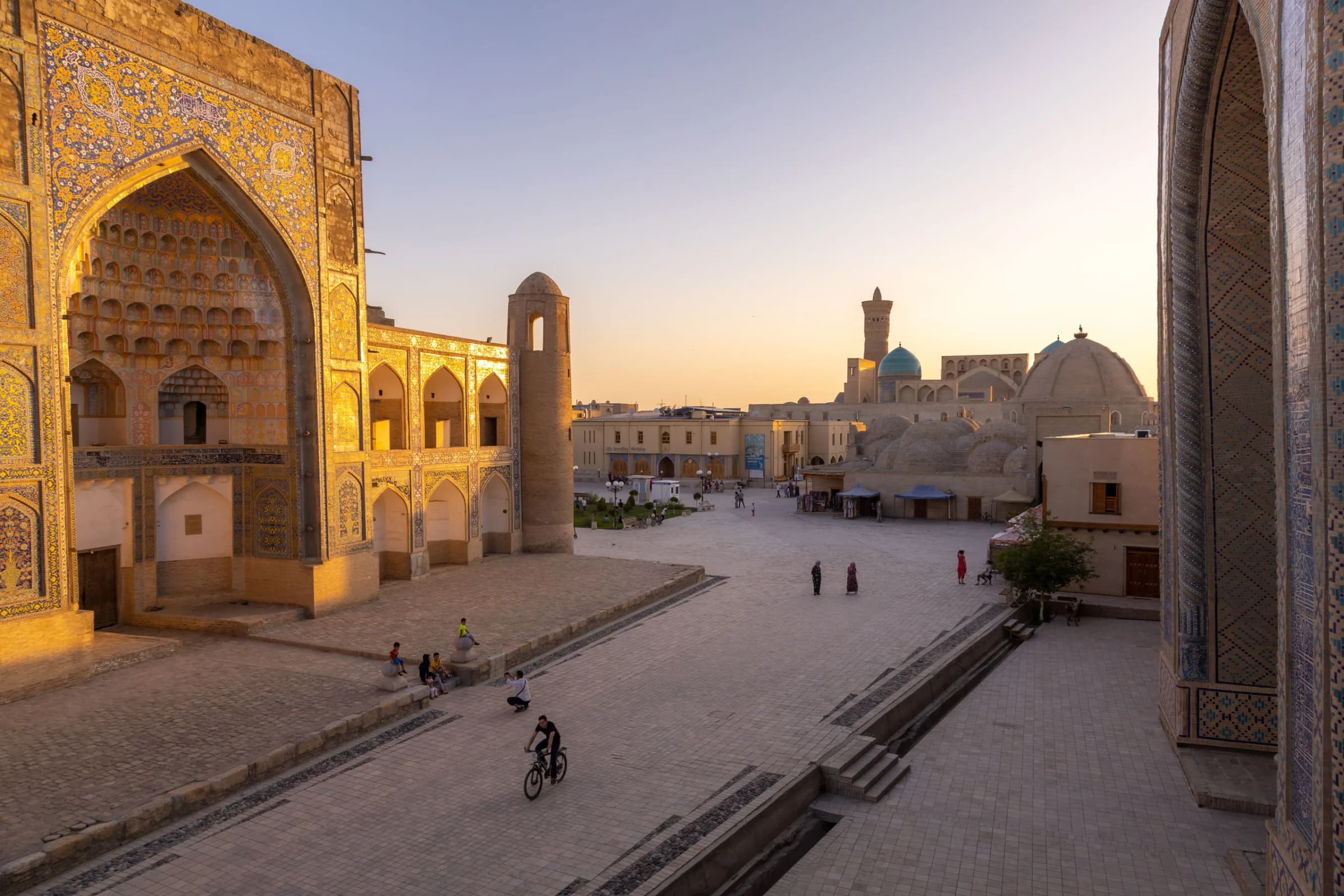
Samarkand has been on the map for 2,750 years. Alexander the Great took it in 329 BC and reportedly said: "Everything I have heard about Samarkand is true, except that it is even more beautiful than I imagined." Two thousand years later, Tamerlane made it his capital and ordered the most ambitious architectural project of his age — buildings so vast and so blue that they still stop conversations today.
Tours
Samarkand tours
Every trip we run through Samarkand, the ones that spend the most nights here first.


Treasures of Uzbekistan
The classic route, at the pace it deserves
- Uzbekistan
- Group 2–12
- Physical2 of 5
- 8 days
From $1,225 USD
private, on your dates

Essential Uzbekistan by Train
Every leg on the fast train — no long drives at all
- Uzbekistan
- Group 1–10
- Physical2 of 5
- 7 days
From $1,555 USD
private, on your dates


Five Cities of Uzbekistan
Tashkent, Samarkand, Shakhrisabz, Bukhara and Khiva
- Uzbekistan
- Group 2–12
- Physical3 of 5
- 7 days
Regular price $1,42529% off
From $1,000 USD
on 17 Nov 2026


This is the city that gives the Silk Road its romance. Three madrasahs facing each other across the Registan, the turquoise dome of Gur-e-Amir over Tamerlane's tomb, the corridor of mausoleums at Shah-i-Zinda where every facade is a different masterpiece. Most travellers spend two or three days here. Most leave wishing they had stayed a week.
Highlights
What you must see
Samarkand's old core is compact — most of the major monuments are within a 20-minute walk of each other. A focused two days covers everything below; three days lets you slow down and revisit favourites at different hours.
01
Registan Square
Three 15th-century madrasahs face each other across an open square: Ulugbek Madrasah (1420, built by the astronomer-king), Sher-Dor (1636, with the famous tigers above the gate), and Tilla-Kari (1660, with a gold-leaf prayer hall inside). Go at sunrise before the buses arrive — the light on the blue tile is otherworldly. Pay the small extra fee to climb the minaret of Ulugbek for the view.
There is no other place on earth where three monumental Islamic facades meet in one square at this scale.
02
Shah-i-Zinda
A narrow alley of mausoleums and ritual chambers built between the 11th and 19th centuries, stretching uphill from the old city. Locals call it the most beautiful corner of Samarkand and pilgrims still walk it for blessings. Each facade is different — geometric tilework, glazed terracotta, blue-on-blue patterns that took artisans decades to perfect.
Tomb architecture across nine centuries, side by side, in a continuous corridor.
03
Gur-e-Amir
Tamerlane's mausoleum — the man who built this entire city — under a ribbed turquoise dome that became the template for the Taj Mahal a few generations later. His tomb stone is a single block of dark green jade, the largest in the world. Visit at dusk: the dome catches the last light.
The visual ancestor of Mughal architecture, including the Taj Mahal.
04
Bibi-Khanym Mosque
Tamerlane built this in 1399 as the largest mosque in the Islamic world to celebrate his Indian campaign. It collapsed within decades — the engineering ran ahead of the ambition — and stood ruined until Soviet-era restoration. The scale is still staggering: the main portal alone is 35 metres tall.
A monument to imperial overreach — and to the reality that some buildings refuse to die.
05
Ulugbek Observatory
In 1428, Tamerlane's grandson Ulugbek — a working astronomer — built a sextant 40 metres long to measure star positions. His catalogue of 1,018 stars stood as the most accurate in the world for two centuries. The instrument is partly preserved underground; the small museum next door explains why it matters.
Working medieval science, at a level Europe would not match until Tycho Brahe.
06
Siyob Bazaar
The living market beside Bibi-Khanym, where Samarkand has been buying its bread, spices, and dried fruit for centuries. The non bread baked here is famous across Uzbekistan — round, dense, stamped with a chekich. Buy one warm. Try the green-tea sherbet in summer.
Not a tourist market — the city's actual food economy, with five centuries of continuity.
Plan your visit
Practical information
Best time to visit
April–May and September–October are ideal: mild temperatures (15–28°C), clear skies, and the light on the tile work is exceptional. Summer (June–August) is hot, often above 35°C, with the major monuments crowded by midday — go before 9 AM and after 6 PM. Winter is cold (down to -5°C) but atmospheric, and there are no tourist groups.
Getting there
The fast Afrosiyob train from Tashkent takes 2 hours 10 minutes and runs several times daily. Tickets cost roughly $15–25 economy and should be booked a few days in advance, especially in season. There is also a slower Sharq train (3 hours), regular flights, and a four-hour drive from Tashkent — but the train is the only sensible choice.
Getting around
Most monuments are within a 20-minute walk of each other in the old city. Yandex Go (the local Uber equivalent) works well and is cheap — typical fare under $3 within town. There is no metro. Taxis flagged on the street work too, but agree the price before getting in (typically $2–5).
Where to stay
Hotels near the Registan or in the old Jewish Quarter put you within walking distance of everything. Mid-range options run $50–120 per night for a comfortable double; boutique hotels in restored merchant houses are $130–200. The newer business district hotels are convenient for one-night transit but miss the point.
Food
Samarkand plov is its own tradition — drier than Tashkent plov, with chickpeas and quince when in season. Try it at lunchtime at a local plov centre, not in a hotel restaurant. Other staples: shashlik (skewered grilled meat), lagman (hand-pulled noodle soup), manti (steamed dumplings). The local samsa from a tandoor oven is excellent. Tap water is not recommended for drinking — bottled is everywhere and cheap.
Photographer's tip: Most monuments charge a small photo or video fee on top of entry (usually $2–5). It's worth paying — the interior tilework of Shah-i-Zinda and Gur-e-Amir is unforgettable, and selfies in front of locked gates aren't.
You might be wondering
Frequently asked
How many days do I need in Samarkand?
+
Two full days lets you see everything important without rushing. Three days is the sweet spot — you can revisit the Registan at different hours, explore the bazaars unhurried, and take a half-day for the Konstantin Konstantinovich-era European quarter most visitors skip.
Is Samarkand safe?
+
Yes. Samarkand is one of the safest tourist cities in Central Asia. Petty crime is rare, tourist police are visible around major monuments, and locals are genuinely welcoming. Standard travel sense applies — don't flash valuables in markets, be cautious with street food hygiene if your stomach is sensitive.
Can I see Samarkand in one day?
+
Only if you have no choice. A one-day visit covers the Registan, Gur-e-Amir, and a quick walk through Shah-i-Zinda — about six hours of intensive sightseeing. You'll miss Ulugbek Observatory, the Siyob Bazaar at any reasonable depth, and the chance to see anything at the right light.
Do I need a guide?
+
Not strictly. All major monuments have English-language information boards, and Google translates the rest. But Samarkand is dense with history that doesn't show on a plaque — the political intrigue behind Ulugbek's murder, why Tamerlane chose green jade, what the tiger on Sher-Dor actually means. A good guide multiplies the experience. All our tours include one.
Is it walkable?
+
The old monument core, yes — flat, paved, and concentrated. Between the old city and the modern downtown (where most hotels and restaurants are), distances become longer. Plan to combine walking with the occasional taxi.
Not seeing your trip?
Tell us what you’re imagining
We design private routes through Samarkand for travelers who want a different pace, other cities, or specific interests. There’s no extra fee for custom planning.
Start a custom inquiry