
Uzbekistan · Travel guide
Bukhara tours and travel guide
A living medieval city, holy and whole
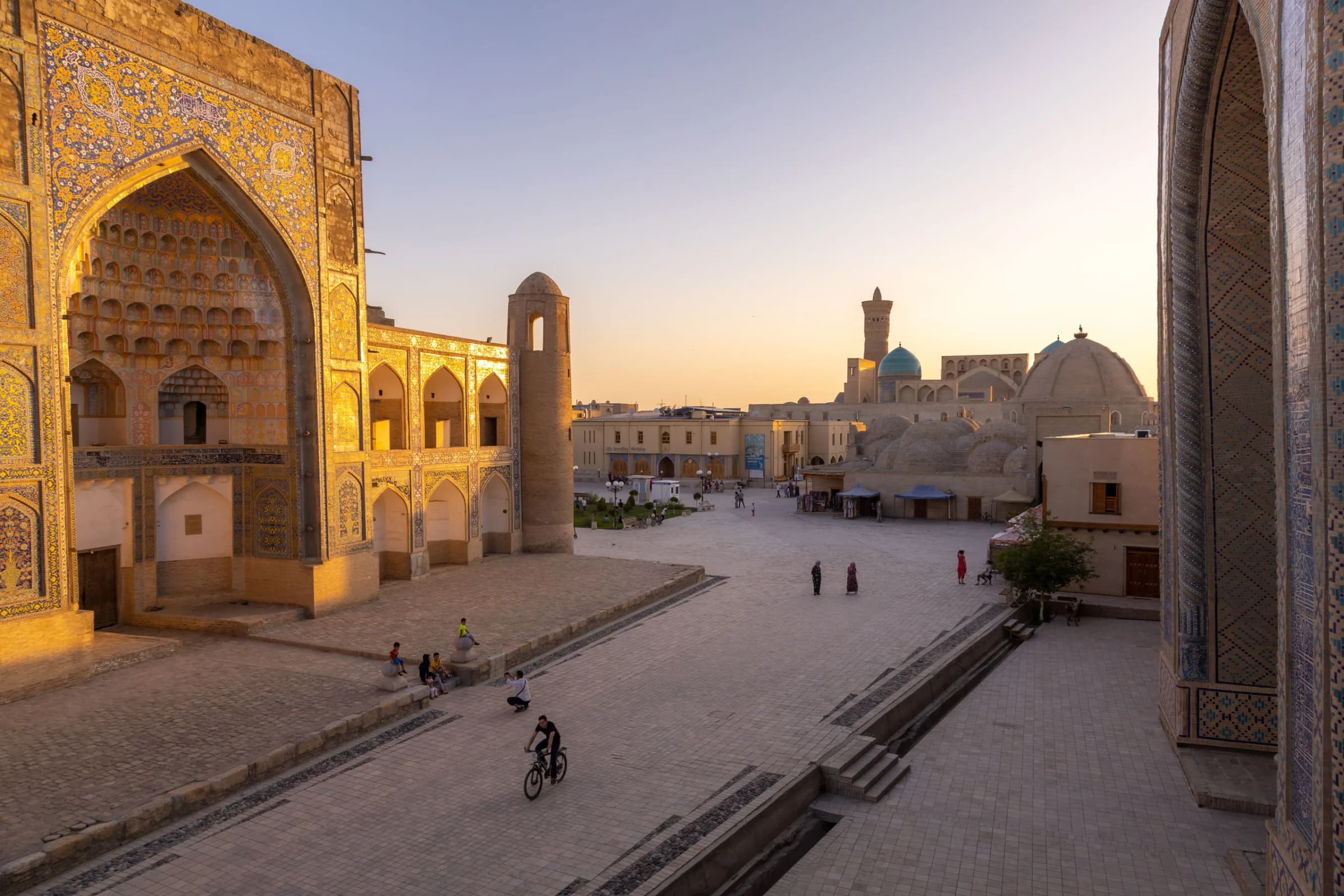
For centuries Bukhara was the holy heart of Central Asia — a city of hundreds of madrasahs and mosques, and a centre of Islamic learning that produced the great traditionist Imam al-Bukhari. Where Samarkand overwhelms with a few monumental set-pieces, Bukhara survives almost whole. You don't visit monuments here so much as walk through a medieval city that is still lived in: covered trading domes, caravanserais, and stone-rimmed ponds shaded by ancient mulberry trees.
Tours
Bukhara tours
Every trip we run through Bukhara, the ones that spend the most nights here first.


Five Cities of Uzbekistan
Tashkent, Samarkand, Shakhrisabz, Bukhara and Khiva
- Uzbekistan
- Group 2–12
- Physical3 of 5
- 7 days
Regular price $1,42529% off
From $1,000 USD
on 17 Nov 2026


Treasures of Uzbekistan
The classic route, at the pace it deserves
- Uzbekistan
- Group 2–12
- Physical2 of 5
- 8 days
From $1,225 USD
private, on your dates


Essential Uzbekistan by Train
Every leg on the fast train — no long drives at all
- Uzbekistan
- Group 1–10
- Physical2 of 5
- 7 days
From $1,555 USD
private, on your dates
More than 140 protected buildings sit inside the old town, most within a slow half-hour's walk of each other. It rewards unhurried time — a morning in the bazaars, an afternoon in the shade by the Lyab-i Hauz pool, an evening when the day-trippers have gone and the lanes belong to the city again.
Highlights
What you must see
Bukhara's old town is compact and largely pedestrian. Two unhurried days cover everything below with time left to wander the trading domes.
01
Poi Kalyan
The monumental heart of Bukhara: the Kalyan Minaret (1127), 47 metres of patterned brick that Genghis Khan reportedly ordered spared; the vast Kalyan Mosque; and, facing it, the Mir-i-Arab Madrasah — still a working seminary, its blue domes among the most photographed in the country.
A minaret so beautiful the Mongols left it standing when they razed everything around it.
02
Lyab-i Hauz
A stone-rimmed pool from 1620 ringed by mulberry trees and framed by the Nadir Divan-Begi madrasah and khanaka. This is the social heart of the old town — tea houses, shade, and the slow rhythm of Bukharan life. Come at dusk.
One of the last surviving hauz (ponds) of the dozens that once cooled the medieval city.
03
Ark Fortress
A royal citadel occupied for well over a thousand years, and the seat of the emirs of Bukhara until the Red Army took the city in 1920. The massive earthen walls enclose throne rooms, a mosque, and museums that tell the ruthless story of the last khanate.
A fortress-city that was continuously inhabited by rulers from antiquity to the 20th century.
04
Ismail Samani Mausoleum
The oldest Muslim monument in Central Asia (9th–10th century), a perfect cube of interwoven baked brick that changes character with the light through the day. It survived the Mongols only because it had been buried in silt and forgotten.
A thousand-year-old masterpiece of brickwork, and the tomb that begins Central Asian Islamic architecture.
05
Chor Minor
A small, endearing gatehouse of a vanished madrasah, crowned by four turquoise-capped towers — each subtly different. Tucked into a residential lane, it is Bukhara's quirkiest landmark and a favourite for the climb to its little roof.
Four minarets on one tiny building — nothing else in the city looks like it.
06
Trading domes & Bolo Hauz Mosque
The covered bazaars — Toqi Zargaron for jewellers, Toqi Sarrafon for money-changers — still trade under their brick domes as they have for five centuries. Nearby, the Bolo Hauz Mosque raises its carved wooden columns over a reflecting pool, the "mosque of forty pillars".
Working medieval market halls, not a reconstruction — commerce on the same spot since the 1500s.
Plan your visit
Practical information
Best time to visit
April–May and September–October bring mild days and the best light on the brick and tile. Summers are hot and dry, regularly above 38°C — plan mornings and evenings, rest at midday. Winters are cold and atmospheric, with the old town almost to yourself.
Getting there
The fast Afrosiyob train reaches Bukhara from Samarkand in about 1 hour 30 minutes and from Tashkent in roughly 4 hours; book a few days ahead in season. Bukhara also has its own airport with domestic flights. The train station is about 10 km from the old town — a short, cheap taxi.
Getting around
The old town is small and largely pedestrian — you'll walk almost everywhere. Yandex Go (the local ride app) is cheap for trips to the station or the newer town, typically under $3.
Where to stay
Stay inside the old town: several hotels occupy restored madrasahs and merchant houses, putting you a short walk from every monument. Comfortable doubles run roughly $40–100; boutique heritage rooms more. Waking up inside the old city is the point.
Food
Bukharan plov is drier and often served with raisins; look for it at lunch when it's fresh. Try shashlik, samsa from a tandoor, and the local sweets around Lyab-i Hauz. The old Jewish quarter is part of Bukhara's story and its food. Drink bottled water, not tap.
Shopping tip: the trading domes mix genuine craft with mass-made souvenirs. Look for the real workshops — miniature painters, coppersmiths, suzani embroiderers — and watch the work being done before you buy.
You might be wondering
Frequently asked
How many days do I need in Bukhara?
+
Two full days is the sweet spot — enough to see the major monuments without rushing and still have time to sit by the Lyab-i Hauz and wander the trading domes. One day is possible but leaves the city feeling like a checklist.
How is Bukhara different from Samarkand?
+
Samarkand impresses with monumental, restored set-pieces — the Registan, the great domes. Bukhara is a whole medieval city that survived largely intact and is still lived in. Samarkand is grander; Bukhara is more atmospheric and walkable. Most travellers are glad they saw both.
Is Bukhara walkable?
+
Yes — the old town is compact, flat, and mostly pedestrian. You can reach every major monument on foot, and getting lost in the lanes between them is part of the pleasure.
Is Bukhara safe?
+
Very. Like the rest of Uzbekistan's tourist cities, petty crime is rare and locals are welcoming. Normal travel sense applies in the busy bazaars.
Not seeing your trip?
Tell us what you’re imagining
We design private routes through Bukhara for travelers who want a different pace, other cities, or specific interests. There’s no extra fee for custom planning.
Start a custom inquiry